

As South Africa marks Youth Month against the backdrop of rising unemployment, cost of living pressure and ongoing concern around youth mental health, new data from Lyra Southern Africa shows that young people are actively seeking support but the strain they are navigating is becoming more complex with age and circumstance.
Across Lyra’s Employee Wellness Programme (EWP), youth engagement spans dependents under 18 through to employees aged 19 to 40, offering a view into how pressure evolves from adolescence into early and mid-career life. More than 32,000 employee cases fall within the 19 to 40 age group, alongside over 2,500 dependent cases linked to employees and accessed through workplace programmes.
This extended access point is significant in a South African context where employer-sponsored support often becomes the first structured point of care not only for employees, but for their families, reflecting broader realities of household dependency and limited access to mental health services.
“Youth support in South Africa does not exist in isolation,” says Dubekile Mugumbate, Business Intelligence and Consulting Manager at Lyra Southern Africa. “What we’re seeing through workplace programmes is that support extends beyond the employee to the household. When a young person reaches out, it often reflects pressure that sits within a wider family system.”
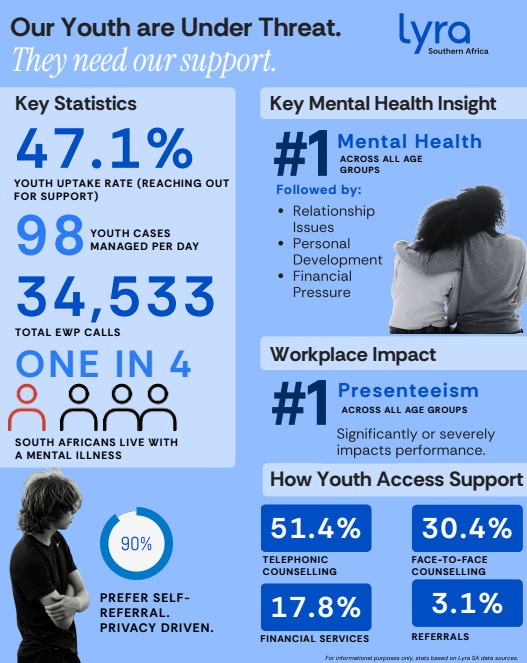
Engagement levels show that young South Africans are not withdrawing from support. Nearly half of youth cases show clinically reliable improvement at closure, with a 47% uptake rate amongst those accessing assistance. At the same time, an average of 98 youth cases is managed every working day, alongside more than 34,500 EWP calls.
These numbers point to both demand and willingness to engage, but they also highlight the scale of need.
The underlying drivers of this demand shift noticeably across life stages. For dependents and employees under 21, the focus leans heavily toward personal development, identity formation, academic anxieties and acute stress events including trauma and family instability. As young people move into the 22 to 30 years of age bracket, financial pressure and relationship challenges begin to take hold alongside mental health concerns. By the time employees reach 31 to 40, these issues compound further with the addition of family care responsibilities, long-term financial commitments and workplace strain.
Mental health however remains the one constant across every age band, with stress and anxiety consistently the most reported concerns. What changes is what sits behind these drivers.
“Young people are navigating very different realities depending on where they are in their lives, but the common thread is pressure,” Mugumbate explains. “For some it is uncertainty about the future and belonging, for others it’s financial survival or supporting a household. These are not separate experiences. They build on one another over time.”
“In addition, many young professionals in South Africa complete postgraduate qualifications part-time while navigating their first jobs. Balancing corporate performance with academic deadlines is a major driver of the presenteeism and exhaustion highlighted in the data,” adds Mugumbate.
These findings reflect the broader national conversations shaping Youth Month, from persistently high youth unemployment and the rising cost of essentials, to increasing awareness of mental health challenges among young people. Many young South Africans are entering the workforce already carrying financial obligations or expectations to contribute to family income, compressing the space for transition and growth typically associated with early careers.
The way young people engage with support also reveals how they respond to this environment. Telephonic counselling accounts for 51.4% of access, followed by 30.4% through face-to-face sessions, showing a balance between accessibility and the continued need for human connection. At the same time, around 90% of cases are self-referred, pointing to a strong preference for privacy and autonomy in seeking help.
“Youth are intentional about how they access support,” says Mugumbate. “The high level of self-referral tells us they want control, confidentiality and minimal barriers. Critically, if support feels exposed or difficult to reach, they are far less likely to engage early.
Despite this engagement, the workplace impact is already visible. Presenteeism is the leading workplace issue across all youth age groups, with a significant proportion of cases affecting performance at a severe or substantial level. This reflects employees who are physically present but mentally and emotionally stretched by pressures outside of work.
What sits behind this is an accumulation of stressors. Young professionals often face steep learning curves, limited structured support and pressure to perform, while also dealing with financial strain, relationship instability and complex home dynamics. In many cases, these factors intersect, making it difficult to separate personal and professional challenges.
Against the current economic backdrop, financial pressure is becoming an increasingly important layer. While not always the initial reason for seeking help, it frequently emerges as an underlying factor shaping anxiety, decision-making and long-term wellbeing.
Mugumbate says organisations need to recognise that traditional approaches to youth support may no longer be enough.
“There is a tendency to think of youth support as a single offering, but the data shows clearly that a one-size fits all approach does not work. A 20-year-old entering the workforce has very different needs to a 35-year-old supporting a family, even though both fall into the same broad category.”
She adds that the opportunity sits in earlier and more responsive intervention.
“If we align support to the realities young people are facing and make it accessible not just to employees but to their families, we can shift outcomes meaningfully. What we are seeing is that when young people do engage, the results are positive. The focus now needs to be on reaching them sooner and supporting them in a way that reflects the full context of their lives.”
As Youth Month continues to spotlight the future of South Africa’s workforce, the data underscores a clear message. Young people are stepping forward and using the support available to them, but the pressures shaping their lives are deep, interconnected and growing. Responding to this will require solutions that are as layered and human as the challenges themselves.