
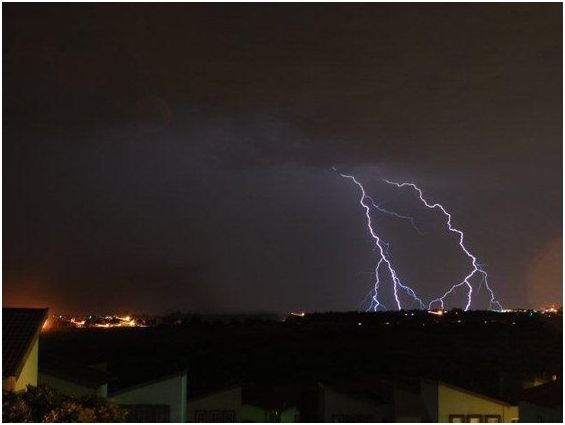
Following Recent Incidents in Gauteng Recent reports of people being struck by lightning in Majaneng in Gauteng have raised serious concerns about public safety during the current thunderstorm season. These incidents serve as a critical reminder that lightning poses a real and significant danger, particularly in the eastern half of South Africa, as demonstrated on Figure 2, which is one of the most lightning-prone countries in the world.
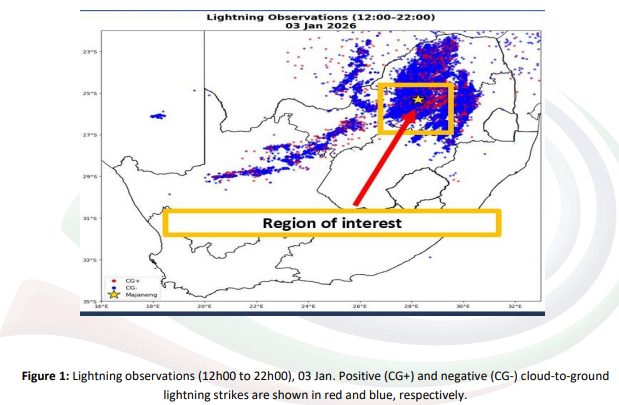
Figure 1: Lightning observations (12h00 to 22h00), 03 Jan. Positive (CG+) and negative (CG-) cloud-to-ground lightning strikes are shown in red and blue, respectively.
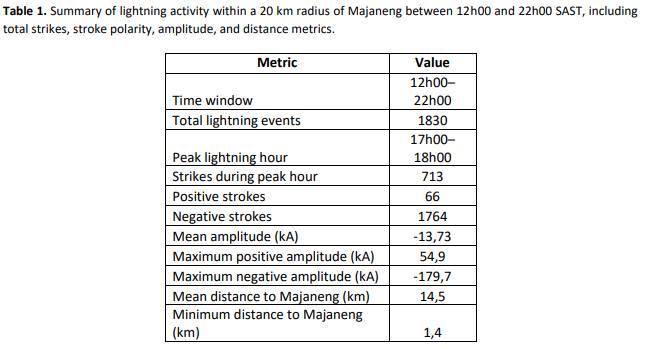
A total of 40 people were reported to be hit by lightning around Majaneng (shown in figure 1), a rural village in the Hammanskraal area, near Pretoria. Between 12h00 and 22h00 SAST when the event was active, lightning within a 20 km radius of Majaneng was intense and concentrated, with 1,830 strikes recorded (Table 1). Activity peaked between 17h00 and 18h00, with 713 strikes (39%). The events were mostly negative cloud-to-ground strokes (1,764 negative vs 66 positive), with a mean amplitude of −13,73 kA, though some strong positive strokes reached 54,9 kA, indicating mature storm stages and surface hazard. The negative strokes were much stronger, with maximum of -179,7 kA recorded, indicating an exceptionally powerful lightning strike during the period. Lightning occurred at a mean distance of 14,5 km, but the closest strike was 1,4 km, showing direct risk to the settlement.
Table 1. Summary of lightning activity within a 20 km radius of Majaneng between 12h00 and 22h00 SAST, including total strikes, stroke polarity, amplitude, and distance metrics.
The lightning observation map for 3 January 2026 (12h00 to 22h00 SAST) shows intense thunderstorm activity over northern parts of Gauteng, with a high concentration of cloud-toground (CG) lightning strikes in and around the highlighted region of interest (Figure 1). This period coincides with the timeframe during which fatalities and multiple hospitalisations were reported at the troupe event.
Figure 2: Lightning ground flash density for 2006 – 2022 (flashes /km2 ) South Africa is one of the most lightning-prone countries in the world, and long-term observations show that lightning risk is not evenly distributed across the country. The Lightning Ground Flash Density map for 2006-2022 illustrates the average number of cloud-to-ground lightning strikes per square kilometre, revealing clear regional patterns linked to climate and topography (Cecil et al., 2014).
The highest lightning densities occur over the north-eastern interior, particularly Mpumalanga, Limpopo and parts of northern KwaZulu-Natal, where values locally exceed 15 to 20 flashes per square kilometre. These regions frequently experience intense summer thunderstorms, driven by strong surface heating, deep atmospheric instability and an influx of warm, moist air from the Indian Ocean (SAWS, 2017).
Much of the central interior, including Gauteng, the Free State and North West, shows moderate lightning activity of approximately 5 to 10 flashes per square kilometre. This reflects the Highveld’s climatology, where afternoon and evening convective storms are common during the summer rainfall season (Christian et al., 2003). Lightning is strongly associated with deep convective clouds, which develop most readily in warm, moist and unstable environments, conditions that are far less common in the western parts of the country (Rakov and Uman, 2003).
How Lightning is Formed
Lightning occurs during thunderstorms when strong updrafts and downdrafts inside storm clouds cause collisions between water droplets and ice particles. These collisions lead to the separation of electrical charges, with positive charges accumulating at the top of the cloud and negative charges at the base. When the difference between these charges becomes too great, electricity discharges as lightning, either within the cloud or between the cloud and the ground.
Energy Released by Lightning A lightning strike releases an enormous amount of energy in a very short time, heating the air within the lightning channel to approximately 30 000 °C, hotter than the surface of the Sun, and generating peak electrical currents of around 30 000 amperes in return strokes (Britannica, 2025). These extreme temperatures and currents result from the rapid ionisation of air and the discharge of huge electrical potential differences, and can cause fires, explosive shock waves, and structural damage. Electrical currents of only a few amperes can be life-threatening to humans; therefore, currents on the order of tens of thousands of amperes deliver an immense pulse of electricity that can interrupt cardiac rhythm, cause severe burns, nervous system and internal organ damage, and be fatal even without a direct hit (Blumenthal, 2018; Song et al., 2024). Research into lightning physics further shows that the dynamic current and energy release in discharges are core factors in how lightning interacts with the environment and infrastructure, which underpins the design of protection systems and hazard assessments (Song et al., 2024).
How People are Struck by Lightning
People do not need to be hit directly to be harmed by lightning. Injuries commonly occur through ground current, where lightning strikes the ground and electricity spreads outward. Other mechanisms include side flashes from nearby objects such as trees or poles, contact with conductive materials like fences, and direct strikes. Ground current is the leading cause of lightning-related injuries in South Africa. Gatherings in open spaces significantly increase the risk of multiple injuries. Factors that contribute to this include standing close together, the presence of tall objects or temporary structures, metal equipment, elevated terrain, and delays in seeking shelter. Temporary shelters such as tents and gazebos do not provide adequate protection against lightning.
Precautions During Thunderstorms
The public is urged to take lightning warnings seriously. If thunder is heard, it means lightning is close enough to pose a danger. Outdoor activities should be stopped immediately, and people should seek shelter in fully enclosed buildings or inside vehicles with closed windows. People should avoid open fields, hilltops, trees, metal fences, poles, water bodies, and temporary structures. If no shelter is available, individuals should spread out, crouch low with feet together, minimise contact with the ground, and avoid lying flat. After a thunderstorm, activities should only resume at least 30 minutes after the last sound of thunder. It is important to note that lightning strike victims do not carry an electrical charge, and it is safe to assist them. Emergency services should be contacted immediately, and CPR should be administered if trained to do so. Lightning-related injuries and fatalities are largely preventable through awareness, preparedness, and timely action. Communities, event organisers, schools, and workplaces are encouraged to prioritise lightning safety and to follow weather alerts issued by the South African Weather Service, particularly during the summer thunderstorm season. The South African Weather Service offers a buffer zone lightning alert service that provides advance warnings of lightning activity. An example is shown below, highlighting the anticipated start and end times of lightning occurrence. These alerts help reduce the risks associated with thunderstorms by notifying users of potential lightning hazards within a specific area. For more information about this service, please contact [email protected].
Figure 3: Image showing a Lightning alarm signal indicating the start of lightning activity.
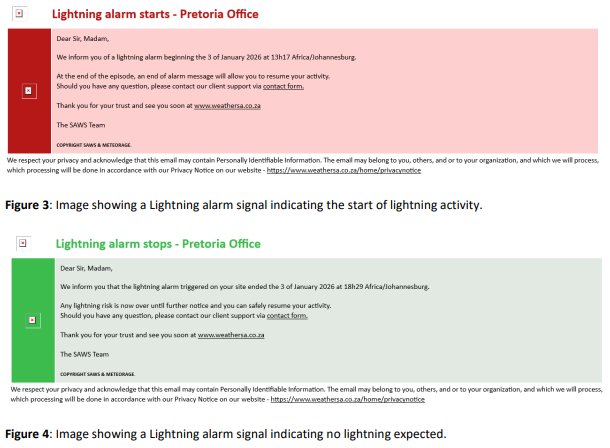
Figure 4: Image showing a Lightning alarm signal indicating no lightning expected.
The South African Weather Service will continue to closely monitor evolving weather and climate conditions and will provide weekly updates and early warnings where necessary to support public safety and preparedness.
References Britannica (2025) Lightning. Encyclopaedia Britannica. Available at: https://www.britannica.com/science/lightning-meteorology (Accessed: 5 January 2026). Encyclopedia Britannica Blumenthal, R. (2018) ‘Lightning and the forensic pathologist’, Academic Forensic Pathology, 8(1), pp. 98-111. PMC Song, Y., Xu, C., Li, X. and Oppong, F. (2024) ‘Lightning-Induced Wildfires: An Overview’, Fire, 7(3), 79. Cecil, D.J., Buechler, D.E. and Blakeslee, R.J., 2014. Gridded lightning climatology from TRMM-LIS and OTD: Dataset description. Atmospheric Research, 135-136, pp.404-414. Christian, H.J. et al., 2003. Global frequency and distribution of lightning as observed from space by the Optical Transient Detector. Journal of Geophysical Research: Atmospheres, 108(D1), pp.4005-4019. Rakov, V.A. and Uman, M.A., 2003. Lightning: Physics and Effects. Cambridge: Cambridge University Press. South African Weather Service (SAWS), 2017. Lightning climatology of South Africa. Pretoria: South African Weather Service.
Compiled by: Lehlohonolo Thobela, Innocent Mbokodo and Musa Mkhwanazi
Edited by: Ezekiel Sebego, DRR Manager
Approved by: Rudzani Malala, DRR Senior Manager
For technical and weather enquiries: National Forecasting Centre: Tel: 012 367 6041
– with Elias Nel.